
Part Two: How the Beatles Changed the World, Music, and Culture — Quotes from Global Icons

May 14
28 min read
Updated: 23 hours ago
Just how did the Beatles change the world? Dive into a curated collection of quotes from notable musicians, artists, and cultural figures celebrating the Beatles as the most influential and greatest band of all time.

From classic rock, heavy metal, and punk to hip-hop, rap, classical, blues, soul, country, pop, and more, read powerful quotes from notable and influential musicians, artists, and cultural figures revealing how the Beatles influenced them personally, transformed the music industry, and shaped global culture. This curated collection highlights why the Beatles are widely considered the most influential and greatest band of all time, featuring tributes from many of the biggest icons across genres and decades.
This is part two. Part one is here:
(Note: I'm always updating this with new quotes as I find them. Feel free to bookmark and share.)
***
Ozzy Osbourne (Black Sabbath): My son says to me, "Dad, I like the Beatles, but why do you go so crazy?" The only way I can describe it, is like this: Imagine you go to bed today and the world is black and white and then you wake up, and everything’s in color. I owe my career to them because they gave me the desire to want to be in the music game.
They broke the fucking doors down for so many people, and they gave freedom to the world… When I first met Paul McCartney, it was like meeting Jesus Christ… I just know that every time I heard something from the Beatles, it made me feel better that day.
Steve Jones of the Sex Pistols once said to me, "I hated the Beatles." I said, "There is something fucking wrong with you." To me that's like saying you hate air.
John Lydon (Sex Pistols): I remember hearing “Working Class Hero” while I was in a pub with Malcolm McLaren, about 1975, when we were just starting the Pistols. He took us across the road for one drink each – ah, so kind that man! – and “Working Class Hero” was on the jukebox. It stuck in my mind, because it was such a relevant and important record. I’d heard it beforehand, but then it didn’t mean much. This time I related to it. The anger and the bitterness seemed utterly genuine, the words came out with such passion and violence. That was part of the building block for me, of songwriting in the Pistols. That you could shift into these larger aspects – class hatred, anger, resentment – and get it right.
But in my memory, there's always a great place for John Lennon. Always. "Working Class Hero" and the album Imagine are highlights of my musical collection.
Jimmy Page (Led Zeppelin): The Beatles are the only group I can think of in rock ‘n’ roll history that improved to such heights from their early days. It was incredible the way they kept improving; it was like an avalanche. I don’t see how anybody could not have been touched by something that they did, even if they were cynical. From all the songs they did, from their beginnings right up through the end, there’s no way that you could not have been touched by that.
Fred Armisen (comedian, writer, & musician): Whenever anyone says they don't like the Beatles, I always think they're just trying to be shocking. I'm like, 'I get it. You're against everything.' But I think secretly, people who say they don't like their music actually like it.
David Coverdale (Whitesnake, Deep Purple): I remember thinking a lot of my youth was black and white, you know, monochrome in post-war England. Everything seemed to be black and white, and then the Beatles came along and everything looked like fucking rainbow colors! (On hanging out with George Harrison) He was terrific. I never stopped pinching myself, really, because he was the man. George invited me to Friar Park and ribbed me about my fondness for Beatles memorabilia and trivia. Then he took me into his studio and showed me the Fender Stratocaster that he'd played on Magical Mystery Tour, plus his Sgt. Pepper suit. It was magical.
Mark Hamill (actor & producer): When The Beatles came out, everything changed, where you go, "I'm not spending any money on comic books anymore. Gotta save up money for the records." The Beatles' generation, I'm telling you, it just rocked our world. I mean, they talk about going from black and white into color. The day after they were on The Ed Sullivan Show, there was nobody at school who had not seen 'em. And then A Hard Day's Night — we couldn't believe it, how funny they were and it seemed like a documentary, you know, we'd never heard those accents before, and Lennon was so acerbic and all of it, it was just perfect.
Cameron Crowe (filmmaker & journalist): I’ve often asked actors to sit down and watch A Hard Day’s Night with me just to get an idea for energy and enthusiasm and a way to embrace life. I keep trying to rip off A Hard Day’s Night, frankly.
Nancy Wilson (Heart): The lightning bolt came out of the heavens and struck Ann and me the first time we saw the Beatles on The Ed Sullivan Show. There’d been so much anticipation and hype about the Beatles that it was a huge event, like the lunar landing. That was the moment Ann and I heard the call to become rock musicians. I was seven or eight at the time… Right away, we started doing air guitar shows in the living room, faking English accents, and studying all the fanzines.
Leonard Bernstein (composer): I fell in the love with the Beatles’ music (and simultaneously, of course, with their four faces-cum-personae) along with my children, two girls and a boy, in whom I discovered the frabjous falsetto shriek-cum-croon, the ineluctable beat, the flawless intonation, the utterly fresh lyrics, the Schubert-like flow of musical intonation and the Fuck-You coolness of these Four Horsemen of Our Apocalypse...
The notes healed, the words teased; or perhaps it was vice versa. But something teased, and something healed, year after year, Rigby after Rigby, Paperback after Norwegian … today I am almost 64, and three bars of "A Day in the Life" still sustain me, rejuvenate me, inflame my senses and sensibilities.
Neil Innes (writer & comedian): John had the sharpest, quickest mind, I think, and the others rolled along with it.
John, when he did his bed-ins and all the rest of it, he was actually using comedy to sort of make a very serious point. He was trying to use the same techniques that advertising campaigns do to flog the idea of peace and love. Yes, he stuck his head over the parapet, and people were taking potshots at him, but it was nevertheless a very courageous and funny, serious, funny thing to do. To sort of take on the received wisdom of the times, in a way, and how we’re all sucked into the message and the machine and all the other jargon and buzzwords for it. But the bottom line is that everybody is alone in this life, and we’re all alone together. And when he started talking about, you know, well, actually, if we were nice to each other, how about trying that for a while? It’s not a bad idea.
John Travolta (actor): The Beatles meant everything to me growing up, and John was part of that. I loved Lennon's persona. He knew who he was and he knew what he represented to a worldwide public. John knew he had the floor; he knew he had to parlay that into something. I think he incited and inspired a whole group of youth to speak out and say what they felt.
Every man and woman represents a Beatle. You're either a Paul type, a George type, a Ringo type or a John type.

John Ritter (actor): Yes, I got the Beatles poster and made them put it up [above Jack Tripper’s bed].
There's a book called The Last Days of John Lennon by Frederic Seaman. He said [Lennon] was a couch Beatle who sat there with the sound turned off [his TV] all day; and he had three favorite shows: The Tonight Show, Dallas, and Three's Company. Reading that almost made me pass out. He was my idol. And the fact that John Lennon knew who I was and maybe I made a difference in his life — maybe he cracked up or maybe he said 'Who are these idiots on Three's Company?' But whatever it was, he must have seen that Beatles poster. I was always obsessed with John Lennon; I loved his work and listened to and read everything he did.
I got to work with Ringo on his NBC TV special, which was a dream come true. He is genuinely hysterically funny without even trying. And I got to meet George Harrison. I ran up to him on the beach on Hawaii and said, 'Mr. Harrison, I'm sorry to bother you, but look...', and I pulled out one of his solo recordings on tape that I was listening to on my headphones, and he was really thrilled.
I've never met Paul, but I saw John Lennon record one night, and he looked over at me. I tried to smile, but I was so nervous and excited that my face looked like a bad Peewee Herman imitation. I was trying to nod and go, 'Hey, guy.' But it was 'HAWEEGEEGUIEEEE!' And he looked away. Probably called the cops.
Elton John (singer, composer, & pianist) on John Lennon: He would take my band to the airport and make sure my mother was OK. I've never met anybody more thoughtful. I know you read in some books that John would be cruel and had a very cynical sense of humor, and I've seen that side of him too. I was with him at a particularly crazy time for him and for me. But underneath it all, I never saw anything else but kindness.
He is the only person in this business who is absolutely, one hundred percent sacred to me. And even if I'm doing bad things to myself, or if I'm being totally miserable or morose, or being unreasonable to people, I sometimes think, "Oh my God, John, if there is really a big pearly gate, you're going to be standing outside of it and giving me the biggest lecture."
That's because he's the only person in this business that I've ever looked up to, the only person. I've met my equals. I've met people who are great like Mike Jagger and Pete Townshend, who I admire tremendously, but they are not in the same league, I'm sorry.
May Pang (John & Yoko’s former personal assistant and John's former girlfriend): What people don’t realize about John [is that] he was actually more shy than most people would think, you know? He loved to be with people, but he was introverted. He didn’t take himself as a big superstar. He knew he was, you know, you just know it, but you don’t take yourself that seriously. I remember we were sitting there, we were watching television, and an advert came on, and it said the legendary Eric Clapton. And he says, ‘Boy, that’s tough, because I couldn’t live up to that.’ I said, ‘Live up to what?’ And he said, ‘Legendary.’ And I’m looking at John going, ‘You don’t think you’re a legend?’ He goes, ‘Oh no, not me. I’m not that.’ He didn’t take himself that serious. He had no idea, in one way. He knew he was famous in another way, if we were out there, he’d go, ‘Yes, I know I am.’ But he didn’t take himself like that at home or say, ‘I am John Lennon.’ He’ll say it when you need to, I guess, when we’re out and about and people are at you.
Marianne Faithfull (singer-songwriter & actress) on John Lennon: His legacy? It's hard to put into words. I mean, it's nothing really: He just changed the face of popular music forever, didn't he?

Richard Perry (record producer): John Lennon was the most exciting person I’ve ever been in the studio with. His energy was overwhelming. The natural force and strength of his personality, he lifted everybody in the room up. I can remember very distinctly every minute with him; it was probably the greatest thrill of my career.
Eric Carmen (singer-songwriter): John Lennon was the most charismatic person I’d ever met. Period. Bar none. I’ve met a lot of rock ‘n’ roll people over the years, some that I had idolized... and some were cool and some weren’t, but they all seemed pretty much human. John was really just overpowering in person.
Howard Stern (media personality) on air in Detroit on the morning of December 9th, 1980 after John Lennon’s murder: I have never been so moved or shocked in my whole life. And you know me… I see David Lee Roth and I see Steve Perry, these guys, they come by the station, I mean these guys are just rock ’n’ roll stars. To me, John Lennon is like a… he changed my whole life. John Lennon to me was one of my biggest heroes because he was an individualist, he was more than just a rock ’n’ roll star, the man was a renaissance man.
I tell you, the Beatles - Number One band of all time. Sgt. Pepper's, Magical Mystery Tour... forget all those albums; if they had only put out Rubber Soul - if they had only put out Help! - you would have said, oh my god, that was the greatest band ever. If you want to sit and argue you're a mutant. You don't even know what you're talking about. It's always the Beatles, in any discussion.
Don Henley (The Eagles): I admired John Lennon more than anybody in the music industry. I loved his voice, I loved his sense of humor, I loved the songs he wrote, the lyrics he wrote. I loved what he stood for, what he believed in, everything about him, really. He was my biggest hero.
David Bowie (singer, songwriter, & actor): It's impossible for me to talk about popular music without mentioning probably my greatest mentor, John Lennon. I guess he defined for me, at any rate, how one could twist and turn the fabric of pop and imbue it with elements from other art forms, often producing something extremely beautiful, very powerful and imbued with strangeness.
Bonnie Raitt (musician): I was a John Lennon nut; I just thought he was it. A whole wall of pictures, a picture of him on my pillowcase so I could kiss him goodnight... It was sick, really.
Michael Hutchence (INXS): I always had a soft spot for the Beatles, especially John Lennon.
Graham "Suggs" McPherson (Madness): I remember being in primary school, and the playground was very much divided between The Rolling Stones and The Beatles. I was on The Beatles side and I remember four of us standing on a school bench singing “Twist and Shout” pretending we were Beatles. I think I was John, because I had one of those hats with the ear flaps and mittens with elastic, which I think is very John-esque.
(On John Lennon’s song “Mother”) Because I didn’t have much of a family when I was young, and the song is all about ‘Father I needed you / but did you need me?’ it’s a very, very sad song and it always really gets to me when I hear it.

On John Lennon’s first solo album, John Lennon/Plastic Ono Band (1970):
Stephen Holden (writer & film/music critic): An anomaly in rock history, John Lennon/Plastic Ono Band has never really been imitated, though it set off reverberations that affected such disparate genres as the singer/songwriter school of confession and the punk-rock blast of the late Seventies. To call the disc a masterpiece is not an overstatement.
[Lennon’s] furious howls of frustration in "Mother," "Well Well Well" and "Isolation" gave no quarter and had no precedent in rock & roll.
Greil Marcus (author & music journalist/critic): The record was a full, blistering statement of fury, resentment and self-pity, and Lennon's proof that the true power of rock as music is to be found in stripping it as bare as primal therapy was supposed to strip the soul… the music didn't cut, it bit... John's singing on the last verse of “God” may be the finest in all of rock.
Robert Christgau (music journalist & essayist): Unsurprisingly, Lennon did grim smarter than Black Sabbath. The historic scale and analytic detail of "Working Class Hero," "I Found Out," and "Isolation" have always been rare virtues in political pop, and the patterns of oppression they lay out have only gotten worse since… And as you listen deeper you realize that the music isn't stark at all… Every note reverberates. The drums Ringo Starr pounds seem funereal, just as the piano Lennon pounds seems orchestral. And left out in the open, without protective harmonies or racket, Lennon's singing takes on an expressive specificity that anyone in search of the century's great vocal performances would be foolish to overlook.
Paul Evans & Milo Miles (music writers/critics): It's rock & roll as Lennon always understood it: anger, catharsis, deliverance… Plastic Ono Band is also one of the finest - singing with more verve than he'd mustered since the Beatles' "Money," his urgency encouraged by primal scream therapy with Arthur Janov, Lennon bares his soul… "God," "Remember," and 'Isolation" find John unburdening himself of an exhausting, mythic past and seeking - through harsh, nihilistic exhilaration - release.
"Well, Well, Well" and "I Found Out" are tougher rock than nearly anything released before the Sex Pistols; "Mother" is painful, lovely, and spine-chilling. And with "Working Class Hero" Lennon shucks off his gigantic stardom and reclaims the black-leather spirit of his Liverpool youth.
Lenny Kravitz (musician): It’s the music. It’s the bottom line. If the music wasn't good, we wouldn't be sitting here talkin’ about ‘em right now... The Beatles' music was revolutionary. The combination of those four players was one in a billion. The way that worked out, the time that it happened. It has changed the planet. And I don’t know that will ever be repeated.
Today, I think John would be doing some cutting-edge hardcore music. His first solo record is one of the most hardcore pieces of music ever recorded. And at the end of "Mother," when he's saying, "Mama, don't go, Daddy, come home," his soul is just spilling out; it's so hardcore.
[McCartney’s] a modern-day Mozart. Let's be real. I'd like to see the best writer today write his worst song. A lot of people [who give him grief] don't have ears. They don't realize what it takes to write a great song. It's like people [who] say Ringo can't play drums. He's amazing. He's a lyrical drummer. He moves with the music. How can you not love the Beatles and McCartney?
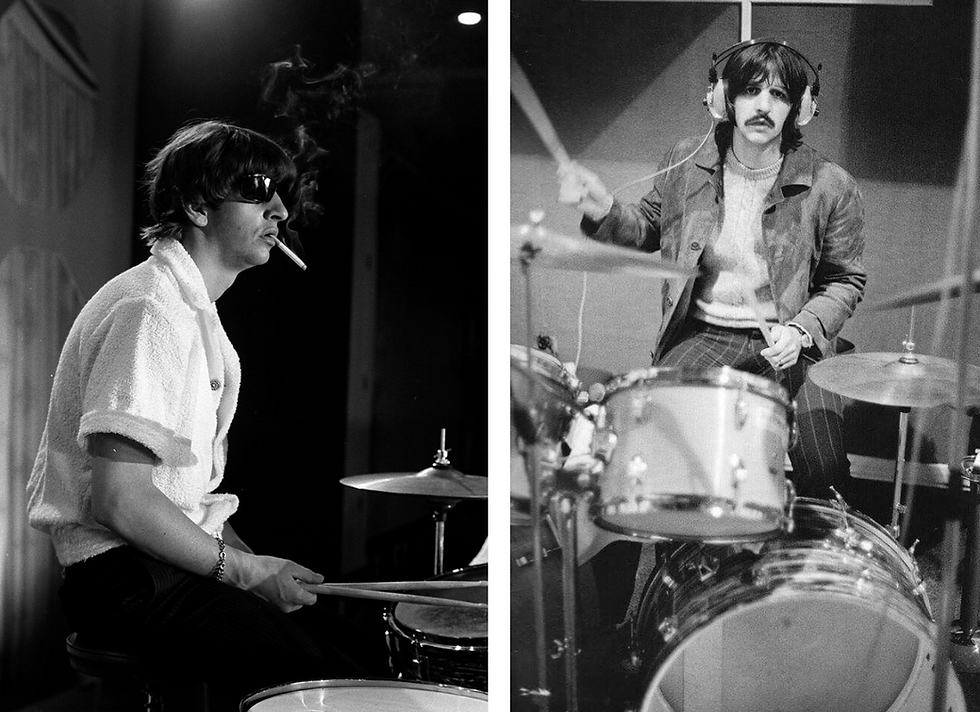
Kenny Aronoff (touring & session drummer): [Ringo’s] the reason why I play drums… the reason why I play in rock & roll bands. I consider him one of the greatest innovators of rock drumming and believe that he has been one of the greatest influences on rock drumming today... Ringo laid down the fundamental rock beat that drummers are playing today and they probably don't even realize it. [He] always approached the song more like a songwriter than a drummer. He always served the music.
Steve Smith (drummer, Journey): Before Ringo, drum stars were measured by their soloing ability and virtuosity. Ringo's popularity brought forth a new paradigm in how the public saw drummers. We started to see the drummer as an equal participant in the compositional aspect. One of Ringo's great qualities was that he composed unique, stylistic drum parts for The Beatles songs. His parts are so signature to the songs that you can listen to a Ringo drum part without the rest of the music and still identify the song.
T-Bone Burnett (musician & producer): Ringo was the fire, totally the fire underneath that band. I think of what McCartney said, that the first song they played with Ringo, they all just looked at each other. Because he was the soul of rock ‘n’ roll, man. That cat, his energy was so beautiful and so exciting and wild — just his whole, his spirit is the thing he had. He played with Sister Rosetta Tharp, you know? He played with all of this ecstatic music that would come through Liverpool. And he is an ecstatic musician. The Beatles were all ecstatic musicians, you know, but Ringo was the fire under it... To me, he has as good a claim as anybody to the greatest rock ‘n’ roll drummer of all times, with his tones, the way he hit the drums, the type of beats he played, the way he would construct drum parts where nothing would be playing straight through... Ringo was an extraordinary musician.
Steve Gorman (drummer, The Black Crowes): Ringo Starr's drumming is infallible, untouchable, and he is quite simply the greatest drummer in the history of rock 'n' roll music.
Philip Selway (drummer, Radiohead): Where I come from in Radiohead, what I try to do drumming-wise is to play the song. I know it sounds very simple, but actually you hear so many people who try and make their part over-technical and they lose the emotion of the piece. And for me, Ringo's drumming has always been the pinnacle of actually being part of an ensemble and getting to the heart of what the song is trying to convey emotionally. It really, really comes through in [certain] songs. "A Day In The Life" - that just floors me every time I hear that song. I mean, it's such a complex arrangement that then to have something in there, a drum part, which actually just sings over it - just such a unique voice. And I think that's it: he has such a unique voice.
You can always tell his drumming. And I suppose, for me, that's kind of what I aspire to. One day I'll get there.
Tony Fletcher (author of Dear Boy: The Life of Keith Moon): Keith Moon had admiration for Ringo Starr that bordered on adulation.
John Bonham (drummer, Led Zeppelin): I think the drumming on Abbey Road is really good. The drumming on all the Beatles' records is great. The actual patterns... some of the rhythms on the new album are really far out.
Stewart Copeland (drummer, The Police): Ringo is the leader in the education for all young drummers. Always playing the right things rather than a lot of things.
I go all googly when I meet Ringo... But sitting next to him at a dinner party, what do you say to a Beatle other than, "so, Ringo, how do you like that Ludwig bass drum pedal?" And to my surprise "well, actually, you know, I prefer the Rogers" and we get into a whole discussion. There's little old me talking to a Beatle, Ringo, no less, about bass drum pedals. How cool is that?
Liberty DeVitto (session & touring drummer, Billy Joel): You know, some say Ringo paved the way for us drummers. No, he didn't. Ringo chopped down the trees, Ringo plowed up the dirt, then he paved the road! He did it all, for everybody.
Joe Satriani (guitarist): [The most underrated guitarist is] George Harrison without a doubt. Just think about this, here’s a young kid at the start of a movement. Not someone who ever thought he’d be a virtuoso on the instrument, he was an all-round musician, and he was destined to write two of the most popular Beatles songs of all time, "Something" and "Here Comes the Sun." I want to shout this, I want to put this in capital letters — HE WAS ALWAYS, ALWAYS MUSICAL! Most people can get good physically on the guitar, it’s not really that hard, but to be musical? That’s the real trick. There are a thousand other guitar players that could play rings around George, but what have they played that you really keep in your heart?

Brian May: I hold George in such reverence… everyone raves about people who play fast, but if you look at the catalog of stuff he’s produced, it’s colossal. [He] was a fabulous, fabulous, fabulous guitarist, and a wonderful example of what a rock star should be. I totally revered him as an innovator. He was always fresh, daring, magnificently melodic, full of spiritual quality… and he had the courage to play simple. He never took refuge in effects, or tried to impress with speed. I hope he knew how much we all loved and respected him.
Mick Jones (Foreigner): I'd have to say that I follow the George Harrison approach to playing. George was never the guitar hero type of musician, he played for what enhanced the song, and that's been my approach to all my playing in Foreigner.
Steve Lukather (musician & producer, Toto): The Beatles was my on switch to life. It’s like The Wizard of Oz, where it goes like black and white to color. I was like, you know, 8 years old, 7 years old, and I saw on Ed Sullivan. I said, “George Harrison, I wanna be that guy. Who makes that noise?” I loved ‘em all. When we all saw The Beatles, it was like life changed.
[George] walked into the room and there was a collective gasp. And I was already in a room with a bunch of famous people. It was just, you know — the aura. It’s definitely another level. I mean, there’s no question about that, and there’s nobody who’d argue that.
Mike Campbell (Tom Petty and the Heartbreakers): My favorite guitarist of all time: George Harrison.
Greg Griffin (musician): George Harrison stands head and shoulders about anybody, maybe apart from Lennon and McCartney. There's no people on earth that he might have to wrestle with a bit, apart from them two.
Robbie McIntosh (The Pretenders & session guitarist): As far as most musicians were concerned, until the Beatles arrived, the lead guitarist didn’t exist. George Harrison defined that role. No one should underestimate his achievements. He's often overlooked because his guitar parts are so finely tailored, but if you listen carefully you conclude that they’re perfect. His lead on songs like "All My Loving" is so finely considered, it simply can’t be improved upon. His guitar style came from an era that's probably gone forever, before guitarists starting taking up loads of tracks for different solos. It’s almost impossible to find his sort of discipline these days. His slide work too, is outstanding. It’s unique and his pitching is so precise you can spot it a mile off.
Gary Moore (guitarist, Thin Lizzy): George's solos were constructed like mini masterpieces. I loved his inventiveness, things such as using the volume knob to create the guitar sound you can hear in "I Need You." He didn't just show off, he actually thought about what he was going to play, then composed something unique that became part of the song. The introduction to "Here Comes The Sun" is one example; another is the "Hard Day's Night" solo. That one is actually very fast for its time. To me, George was a phenomenal musician.
Frank Sinatra (singer & actor): Now I’d like to turn to something that, uh, and that so happens to be the title—this is a great song ["Something"] by George Harrison of the Beatles. It’s one of the best love songs, I believe, to be written in 50 or 100 years, and it never says "I love you" in the song, but it really is one of the finest.
Slash (Guns N' Roses): Pretty much all my contemporaries have a thing for the Beatles. Like, really hard-core Beatles fans. I was actually just listening to Abbey Road today. I was heavily influenced by that record. One of the reasons why the Beatles are the standard for songwriting is that, as experimental as they might have sounded, the notes that they chose just seem totally perfect... I think that a hundred, two hundred years from now they will still have that sort of influence.

Anthony Kiedis (Red Hot Chili Peppers): The Beatles never cease to amaze me with their prolific genius.
Dave Navarro (Jane's Addiction, Red Hot Chili Peppers) appearing on VH1's countdown of greatest rock artists of all time: If the Beatles don't come in at #1, there's something absolutely wrong with this show and this entire network.
Jerry Cantrell (Alice in Chains): You can't top The Beatles. They are the kings. It's the stuff that you strive for; it's just great music. To this day, there's rarely a time when somebody puts something out that can compare to what they did. You hope to be around even a fraction of the time that they were, because their music's going to be around forever. That's the hope, man: to get a piece of immortality.
Page Hamilton (Helmet): I always loved "And Your Bird Can Sing" and always felt I could do something cool with it. The degree of guitar difficulty didn't come into my mind. I just love the song, the way it progresses. The Beatles were amazing. There's another song of theirs, "Dear Prudence" - man, there's triads starting at the 15th fret, working through the inversions. Those guys knew their instruments. They were phenomenal musicians. Anybody who questions the musicality of The Beatles, they're just not paying attention.
Ed O'Brien (Radiohead): You have to say about the Beatles: they still are the greatest band. Their music is absolutely extraordinary. What they had in abundance was a kind of magic — magic in the music, magic in the characters. There's something almost divine about them.
Thom Yorke (Radiohead): God, I'm a Beatle obsessive.
Rikki Rockett (Poison) on his biggest influence as a musician: I think the Beatles have been my biggest influence because that’s a band that I’ve liked since I was little and now still. With these new recordings they discover or I’ll go back and rediscover things that they’ve done before and look at it from a different perspective now. So I think that’s probably the stand out for me.
John Legend (singer-songwriter): I love the Beatles. I’ve loved them for a long time and I’ve met Paul and Ringo a few times. One of my favorite memories was a Grammy memory when I sang “Ordinary People." My first big Grammy was when I won Best New Artist. And when I was sound checking, I stepped off stage and Paul McCartney came and told me what a good song "Ordinary People" was, and I was like [sighs with relief, bows, and laughs]. It was pretty cool getting that kind of compliment from one of the great songwriters of all time.
Eddie Vedder (Pearl Jam): I read somewhere that empathy is part genetic. That some people are genetically wired to have more empathy than others. So, it may be predisposed — but I think it's also taught. And I can go back and say that my empathy "muscle" was worked out by Beatles songs. Things like "I'm So Tired," or "Norwegian Wood." Or "Eleanor Rigby" — now that's a song that will put blood into the muscle that is empathy. I think I was taught that through their music.
Dave Grohl (Nirvana & Foo Fighters): If it weren’t for The Beatles, I would not be a musician. It’s as simple as that… I jumped at any opportunity to play with Paul, not only because he will forever be the reason I became a musician, but because he's really fucking fun to jam with… The Beatles really created the blueprint for the rock band. They were four members, and each of them were brilliant musicians and songwriters. As a kid, that’s just how I learned how to be a musician. I had a guitar and a Beatles songbook. And still, to this day, I think that’s all a kid needs to learn how to play music.

Duff McKagan (Guns N' Roses): The first song I learned how to play was the Beatles' “Birthday." Your first song always remains a musical touchstone and this one not only taught me finger dexterity, but also included the rudiments of the whole blues major scale, a scale that I would use and use again in my later career in Guns N' Roses.
When we played Live 8... and we hit the stage and up on stage there's Paul McCartney. And he looks at me and he goes, “Hey Duff.” And so the whole, you gotta hit your nut, you gotta be comfortable, but all I can think is like, “Paul McCartney knows my name. How the hell did that happen?” I've really been able to like, meet my heroes. And, and it's been a pleasure to find out that those guys who are still around, they're around because they worked hard, and they're good guys.
Snoop Dogg (rapper & producer): I had never met [Paul McCartney] before but I’m a fuckin’ fan of the Beatles. They told me, “Sir Paul would like to meet you.” He gave me a hug and I’m like, fuck, Paul McCartney knows who the fuck Snoop Dogg is. This is Paul McCartney, he knows who I am. That’s the experience that I Iove… when the people that you respect, respect you.
Scott Ian (Anthrax): I got to meet Paul McCartney one time. [It was] like being in the presence of a god… If you're not listening to the Beatles, you're not listening to music. If you don't educate yourself on the Beatles... whether you're a fan or a musician, there's nothing better.

Zakk Wylde (Ozzy Osbourne, Black Label Society, Pantera): McCartney? Musicianship and singing? You go from "Yesterday" to "Helter Skelter" to "Maybe I'm Amazed" — that's talent from another planet.
Elle King (singer-songwriter): I sing "Oh! Darling" every night of my life and it's one of my all-time favorite songs ever. I think I would literally give all parts of my body to sing it with Paul McCartney.
Wayne Sermon (Imagine Dragons): I've never even thought of Paul McCartney as an actual human being. He was more like a transcendent vessel of amazing music.
Jack White (The White Stripes): Paul is my favorite Beatle. He’s been a big influence on me — especially the way that he sings. I heard a cover song they did early on called ‘Hippy Hippy Shake’ that Paul sang, and I loved how high he sang it. My voice isn’t comfortable in that higher range, but that song was a big influence on me trying to get my voice somewhere like that.
Krist Novoselic (Nirvana): Dave [Grohl] had sent me an email asking if I wanted to record with Paul McCartney in L.A. And I said, "Dude, I’ll walk there from Washington if I have to." So I flew down and we were standing around figuring out what to do, and I kept thinking, please don’t make me play bass guitar, please don’t make me play bass. That’s like being asked to do karate with Bruce Lee — you’re going to get your ass kicked. Yep, I’m going boxing. Who’s your sparring partner? Muhammad Ali. Good luck with that!... He said he liked my basslines. Paul McCartney said that! You can put that in a pull quote.

Don McLean (singer-songwriter): If Paul McCartney today has a billion dollars, in my opinion he should have ten times that for what he gave the world.
Joe Elliott (Def Leppard): I’m told by relatives that when I was three, four years old, I was pretending to be Paul McCartney with a plastic Paul McCartney guitar, stood on a little stool singing "Love Me Do" to whoever would listen. I was obviously well aware of who the Beatles were and was a huge fan of the singles as a kid. And I’m a huge fan of them now with the new perspective from my sixties.
I think it was probably "Live And Let Die" and "Jet," all the stuff from around ’73 when [McCartney] was rockin’ again. The Band On The Run album, it’s fantastic, my favorite McCartney album. If I want to rock out and I want to listen to McCartney, I’ll be listening to Band On The Run. If I want to sit in the bath with the candles on, I’ll pick Red Rose Speedway.
With the greatest respect to everything he’s ever written in the world ever… I’m going for "Little Lamb Dragonfly" off Red Rose Speedway [as my favorite McCartney song]. It sounded the furthest away from what you’d expect the Beatles to be doing. It wasn’t "Helter Skelter" or "Strawberry Fields Forever" where they were pushing boundaries. It was just a guy, a gentle guitar part, really beautiful melodies. Still, to this day, when I hear it, I get all kind of… squidgy. It’s a beautiful lament, almost like a nursery rhyme.
(On “While My Guitar Gently Weeps”) That's the one that would always get my dad whistling. He never really knew the words, but he knew the melody. I love the chord progression, and it's got a great solo. The whole verse is in a minor feel, but when it gets to "I don't know how..." it goes major. You can hear where Bowie got his early influences from in stuff like this, and I think George Harrison influenced a lot more guitarists than they ever let on - Brian May, Richie Sambora, Joe Perry. I've never met a Beatle, but I did have the pleasure once of having my foot stood on by Ringo Starr. I remember going "Wow!"
Joan Jett (musician) the night she was inducted into the Rock & Roll Hall of Fame: Oh my God. Just seeing all the stars here, it's really cool to see Paul McCartney and Ringo Starr. I remember getting Paul’s [self-titled solo] album and listening to it in my bedroom, and then all of a sudden I’m onstage with him. And it’s very surreal. And amazing. That shows that you can make your dreams come true.
Madonna: When I was told I had to introduce Paul McCartney, something strange happened… I actually got nervous. Now, it takes a lot to impress me, l've met a lot of incredible people. But talent like this comes along about once in a century.
Michael Jackson: I think melodies are always important… especially the Beatle things. The melodies are beautiful. And they're structured so perfectly. That's what makes them stay around so long. "Here Comes The Sun," "Fool On The Hill"— the lyrics are beautiful too, but you don't even really need them.
Angus Young (AC/DC): Even a great band like the Beatles goes off on a detour and does a bit of cabaret for awhile. But you’ll find that the truly great ones always come back to playing real rock and roll... those bluesy fills and huge riffs [in "I Want You (She’s So Heavy)" from Abbey Road] showed they were still terrific rockers right to the end.

Booker T. Jones (Booker T. & the M.G.’s): I wanted to pay tribute to the Beatles because they were doing earth-shaking, groundbreaking things. They were making music that was timeless. They had crossed boundaries and reached heights that no one else in rock 'n' roll had done. They had written timeless melodies.
They had become socially significant. They had become spiritual. They had become funky. And they had done all that in six years! Musically, they had really lived. And then they made Abbey Road on top of everything, which was a complete courageous turnabout musically. I was just struck by it. I would listen to it from start to finish, it was completely creative, everything about it just spoke creativity. At that point, financially, creatively, they didn't have to do anything; obviously, they were doing it for the love of it... and they didn't compromise, they didn't do a commercial album and I thought that was so brave and a big statement.
They're incomparable. It was just such a great gift, that we had them and that the world appreciated them so much. They were so valuable — and so much fun.
Steve Jobs (Apple & Pixar co-founder): My model of business is The Beatles. You know, they were four very talented guys who kept each other’s, kind of, negative tendencies in check. They balanced each other and the total was greater than the sum of the parts. And that’s how I see business. You know, great things in business are never done by one person, they are done by a team of people.
If the vault was on fire and I could grab only one set of master tapes, I would grab The Beatles. The hard one would be between the Beatles and Dylan. Somebody else could have replicated the Stones. No one could have been Dylan or the Beatles.
Ken Burns (filmmaker): I'm an American filmmaker and all of my subjects have been in American history. But I would, in one second, stop and do a series on the history of The Beatles. l've been a Beatles fan all my life, and I would just dive into it with great relish. I think the great sadness would be that I wouldn't have a chance to talk to John or George... but l don't think that would stop me from getting involved in trying to tell the story of the greatest band ever.
Rolling Stone Encyclopedia of Rock & Roll: The impact of the Beatles – not only on rock & roll but on all of Western culture – is simply incalculable. As personalities, they defined and incarnated ’60s style: smart, idealistic, playful, irreverent, eclectic. No group has so radically transformed the sound and significance of rock & roll. … [they] proved that rock & roll could embrace a limitless variety of harmonies, structures, and sounds; virtually every rock experiment has some precedent on a Beatles record.
Larry King (American television and radio host): I came to understand the Beatles' music through the conductor Arthur Fiedler. He said that The Beatles had produced the greatest pop music in centuries. He predicted that their songs would still be listened to in five hundred years. People had no idea of the amazing things they did with chords and arrangements, he said, and to prove it, he'd made an album of their music with The Boston Pops. "You mean," I said, "they're gonna be Beethoven?" "Yes," he said.
Steve Hackett (Genesis): I couldn’t help but be greatly influenced by all of that — the fact that musicians had assimilated the Beatles approach and were coming up with their own versions. Genesis, for example, was a spin-off or a footnote to what the Beatles had done. I guess we were all splinters off the big tree.
Part one:
Sources: The Beatles Revolution ABC TV Documentary (2000), original sources from interviews found online, and https://x.com/BeatlesPraise run by Perry Gartner https://perrygartner.substack.com/
How The Beatles changed the world, music and culture: quotes from global icons * Musicians and bands influenced by The Beatles * Quotes about The Beatles by famous musicians * Heavy Metal musicians influenced by The Beatles * Rap artists influenced by The Beatles * Hip hop artists influenced by The Beatles * Rock musicians influenced by The Beatles * How The Beatles influenced and changed popular and rock music * Country musicians influenced by The Beatles * Pop musicians influenced by The Beatles * Punk musicians influenced by The Beatles * R&B, Soul, and Funk musicians influenced by The Beatles * Famous artists, actors, and people influenced by The Beatles * The Beatles' influence across decades and genres


Comments