
The Benefits of Hiring Professional Voiceover Talent vs. Using AI Voiceover in 2026

Mar 14
9 min read
Updated: Oct 8

When it comes to running a business, it can be incredibly tempting to get swept up in the latest technological shortcuts to cut corners, save time, and preserve your budget. Back in 2017, I wrote about the dangers of the "do-it-yourself" mentality. At the time, business owners were attempting to record their own scripts in echoing offices, calling in co-workers, or asking reluctant family members if they’d step up as the on-call voiceover freelancer.
Oh, how times have changed.
Today, in 2026, the temptation isn't pulling your cousin into a makeshift recording booth; it’s clicking a button on an AI text-to-speech generator. We are living in an era where artificial intelligence can clone, generate, and synthesize human-sounding voices in a matter of seconds. It’s no secret that AI voiceover tools have improved drastically over the last few years, and many business owners are now lumping their crucial audio branding into the "let the machine do it" category.
But here is the undeniable truth: while the technology is impressive, the audio accompaniment to your business videos—which is undeniably more important today than ever before—can absolutely make or break your market and advertising campaigns. Consumers are smarter, their ears are sharper, and they are craving authentic connection more than ever.
Over the past year, I've had a growing number of clients come to me after first trying synthetic AI voices for their projects and videos. Despite the advances in AI, they found the recordings still sounded robotic, monotone, lacked authenticity, and often mispronounced words.
Here are the major reasons why you need to consider investing in a professional human voiceover artist for your business this year, and why relying on AI might actually cost you more in the long run.
The Authenticity Crisis and Consumer Trust
In recent years, the digital landscape has been absolutely flooded with synthetic media. While the robotic, stuttering text-to-speech voices of a decade ago are largely a thing of the past, today’s AI voices bring their own set of modern challenges. Sure, they can sound smooth and replicate a standard corporate cadence, but they often lack the fundamental, messy spark of humanity. Because of this oversaturation, we are currently facing what marketers are calling an "authenticity crisis."

Consumers are bombarded daily with automated emails, algorithmic social media feeds, chatbot customer service representatives, and fully AI-generated ad campaigns. Because of this endless automation, modern audiences have developed a highly sensitive, subconscious radar for anything synthetic. When your potential client hears a recognizable AI-generated voice narrating your brand story, their brain registers a lack of human effort. It sends a subtle but damaging message: If this company didn't care enough to have a real human speak to me, why should I trust them with my time or my hard-earned money?
People buy from people. A professional human voice actor brings warmth, vulnerability, and a lived-in reality to your script that an algorithm simply cannot compute. When you choose a human over a machine, you are actively choosing to invest in brand trust. You are telling your audience that they are worth a real human connection.
Emotional Intelligence: The Human Superpower
If there is one profound element a professional voiceover artist brings to the table that an AI cannot replicate, it is emotional intelligence. A script is never just a collection of words on a page; it is a meticulously crafted blueprint for a feeling. When a human actor steps up to the microphone, we aren't just reading the text. We are interpreting the subtext.
Imagine a script for a healthcare provider. The words on the page might read, "We are here for you when times get tough." An AI voice will read those words with the correct pronunciation and perhaps a generically "soft" tone parameter applied. A human voice actor, however, will infuse those words with genuine empathy, drawing on their own human experiences to deliver comfort, reassurance, and steady confidence. We know when to take a subtle, compassionate breath. We know when to let a word hang in the air for maximum emotional impact. We know how to smile through the delivery so you can literally hear the warmth radiating through the speakers.
AI doesn't know what it feels like to overcome a struggle, to celebrate a massive victory, or to share a quiet, intimate moment with a friend. It only knows mathematical data patterns. When you hire professional voiceover talent, you are hiring someone who can read between the lines and connect with your target demographic on a profoundly human level. We understand the nuances of a sarcastic quip in a commercial, the gentle urgency of a call to action, and the aspirational lift of a corporate brand anthem. Emotional resonance is the currency of modern marketing, and human beings are the only ones equipped to mint it.

Customized Support and The True VIP Collaborative Experience
Let’s talk about the actual workflow. Proponents of AI voiceover often tout the ease of "typing and generating." But anyone who has actually tried to use these tools for a nuanced, high-stakes project knows the immense frustration of "prompt engineering" a voice to sound exactly right. You end up tweaking emotion sliders, spelling words phonetically, adding awkward punctuation to force pauses, and generating take after take just to fix a weird inflection on a single syllable. What was supposed to take five minutes suddenly becomes a tedious, isolating, and frustrating hour-long process.
By contrast, working with a professional voiceover talent one-on-one means you receive customized support that is tailored specifically to you and your business. You aren't just sending text to a faceless server; you are collaborating with a creative partner. You won’t be just another prompt in the queue. Professional artists work with you, side by side, providing a VIP experience to get your video just right.
If you want a read to be "a little more conversational, but with a hint of an authoritative smile," I know exactly what you mean. We can jump on a live directed session via Zoom, Google Meet, or Source-Connect, and you can give me feedback in real-time. I can adjust my pacing on the fly to fit your video's exact timing constraints without distorting the audio quality. This collaborative, dynamic process is not only infinitely more effective, but it is also far more enjoyable. You aren't fighting with a machine; you are creating with a professional.
Beyond the Voice: The Technical Expertise of a Pro
There is a massive misconception in the corporate world that generating an AI voice is the "finished product." In reality, raw AI audio often requires significant post-production to sound broadcast-ready. It can contain weird digital artifacts, unnatural pacing, or phasing issues that ultimately have to be masked by heavy background music.
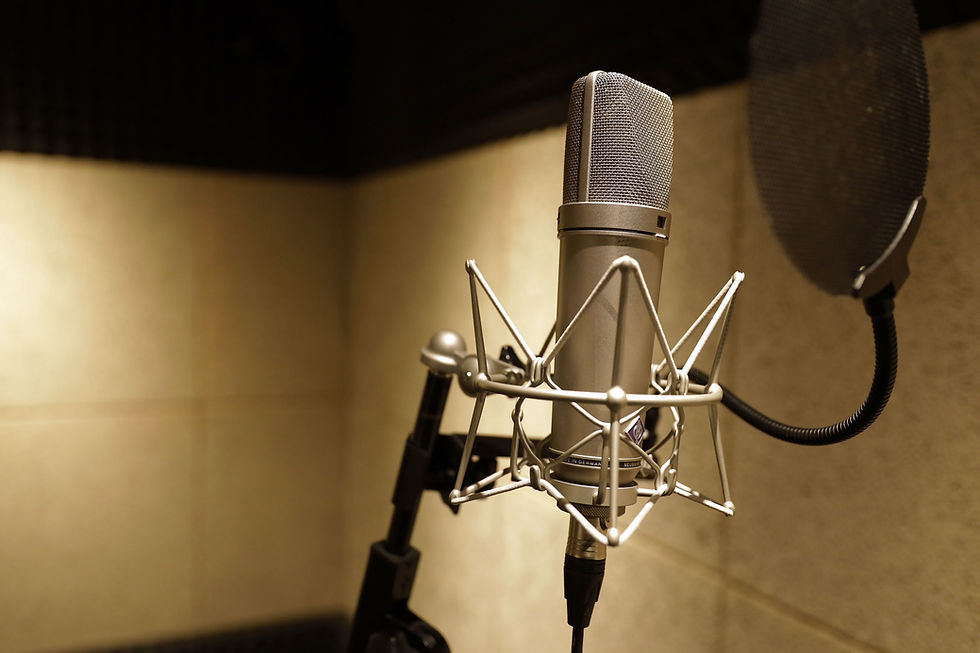
When you hire a professional, you aren't just paying for the vocal cords; you are paying for years of honed expertise, an ear for audio engineering, and thousands of dollars of premium equipment. If you’re thinking of "letting AI do it," just know that a typical professional voiceover artist works with:
Their own broadcast-quality, acoustically treated studio: Ensuring pristine sound without digital hums, echoes, or ambient noise.
Trained experience in audio quality recording: We know our microphones, audio interfaces, and digital audio workstations (DAWs) inside and out.
Intonation analysis and script interpretation: We catch clunky phrasing, typos, and grammatical errors before we even hit record, saving you from embarrassing mistakes.
Multiple targeted takes: Providing you with varied options for your final edit.
Editing and prepping of the final output: You receive beautifully mastered, breath-edited audio files ready to be dropped straight into your timeline.
File conversion based on your exact needs: Delivering in WAV, MP3, or whatever specific broadcast format your production team requires.
These people have made their careers out of voiceover acting, which isn’t exactly something you can replicate with a software subscription. It is a highly specialized craft.
Avoiding the "Uncanny Valley" and Saving Viewer Retention
Have you ever listened to an audio track and felt a strange, inexplicable sense of unease? Everything seems almost right, but something is just slightly off. This psychological phenomenon is known as the "uncanny valley," and it remains a major issue with AI voiceover in 2026.
While AI models have become incredibly sophisticated, they still struggle with the microscopic, organic imperfections that make human speech sound natural. The absence of natural mouth noise, the perfectly uniform breaths (or the unsettling lack thereof), and the occasionally bizarre emphasis on a preposition can instantly pull a listener out of your message.
When a viewer is distracted by the uncanny valley effect, they stop absorbing your marketing message. Instead of listening to the benefits of your product or service, they are consciously or subconsciously wondering, "Is that a real person speaking?" That tiny moment of friction is enough to lose a potential sale. A professional human voice actor ensures that your audience remains fully immersed in your story, completely free from digital distractions. We keep the listener engaged from the first syllable to the final call to action.
Navigating Legal Headaches: Copyright and Brand Safety
One of the least discussed, yet most critical, dangers of using AI voiceover for your business in 2026 is the legal and ethical gray area. Many AI voice generation platforms train their models on vast amounts of scraped audio data—often utilizing the voices of real people without their explicit consent or fair compensation.
When you use an AI voice for commercial broadcasting, who actually owns that voice? Can you copyright the final audio? What happens if your competitor uses the exact same synthetic voice for their ad campaign? Because these platforms are widely accessible, it is entirely possible to hear "your" brand's voice promoting a completely different company the very next day.
When you hire a professional voice actor, you are securing exclusive licensing agreements, clear copyright parameters, and total brand safety. Your brand gets its own unique, proprietary sound that cannot be legally replicated by a competitor. In a crowded digital marketplace, protecting your intellectual property and establishing a distinct, recognizable brand voice is paramount.
Peace of Mind and Long-Term ROI
Running a business, launching a new marketing campaign, or finalizing a complex eLearning module is stressful enough. When you are pressed to meet a tight deadline, the last thing you need is the headache of fighting with an AI platform that continually mispronounces your company's name or your industry's specific jargon.

Going directly to the human voiceover talent source is the right move for getting the project done affordably, quickly, and efficiently. Working with a dedicated professional gives you profound peace of mind. You know the job will be done right the first time, on schedule, and with a level of care and personal investment that a machine simply cannot provide.
Furthermore, investing in a human voice yields a superior Return on Investment (ROI). If you’re considering working with a professional voiceover freelancer, know that this kind of premium audio support to your videos can drastically improve SEO, increase conversion rates, decrease website bounce rates, and improve click-through rates across all platforms. The world still revolves around video, with modern consumers heavily preferring to watch a video over reading an article.
Audio is a massively important part of that video experience, which is why it is absolutely worth the investment moving forward. You cannot automate empathy, and you cannot synthesize a soul. Consider working with a professional voiceover artist who provides customized, human-centered services to clients.
Let's tell your story the way it was meant to be told: from one human to another.
References:
Video Marketing & Consumer Preference Statistics
These sources support the claims that video is essential, quality matters to consumers, and human interaction is vastly preferred over AI:
Wyzowl’s State of Video Marketing Report (2026): This is the gold standard for video marketing stats. It notes that 91% of businesses now use video as a marketing tool, and crucially for your argument, 89% of consumers say video quality directly impacts their trust in a brand. It also highlights that 84% of consumers want to see more videos from brands.
SurveyMonkey: Consumers and AI in Customer Service Study (2025/2026): This study is perfect for backing up the "human superpower" section. It found that 79% of Americans strongly prefer interacting with a human over an AI agent. Furthermore, 61% of people feel human agents better understand their needs, and 53% say humans provide more thorough explanations.
Klaviyo: AI Consumer Trends Report (2026): This report supports the "Authenticity Crisis" section. It reveals that only 13% of consumers completely trust AI, and 32% say AI-generated content makes them trust brands less.
RealVOTalent / Jacobs Media AI Voice Sentiment Index (2025/2026): This specifically targets voiceover. According to their aggregated data, 75% of radio listeners oppose AI cloned voices replacing live talent, and only 13% of consumers trust ads created entirely by AI.
Legal & Brand Safety Risks
These sources support the "Navigating Legal Headaches" section, showing that AI voiceover isn't just an artistic choice; it's a massive legal liability:
Holland & Knight: The NO FAKES Act (2026): A great source detailing the U.S. Senate's advancement of the Nurture Originals, Foster Art, and Keep Entertainment Safe Act. This legislation holds companies liable for producing unauthorized digital replicas of someone's voice, highlighting the exact copyright and branding dangers mentioned in the post.
Omni Legal Group: AI, Copyright & Creativity (2026): This legal blog explicitly warns businesses that if an AI track uses a specific voice or identity directly, legal exposure increases dramatically. It advises that businesses need to secure copyright and trademark protections, which are inherently murky with AI outputs.
Professional voiceover talent vs AI, human voiceover vs AI voice generator, benefits of hiring a human voice actor, 2026 video marketing trends, authentic brand voice, voiceover for business, AI voice legal risks, custom voiceover services, human connection in marketing, professional VO studio


Comments